
Company Formation in Venezuela
Maintenance, compliance and exit for entities already established
Formation Process
Venezuela has one of the more complex company formation processes in Latin America, with registration through SAREN (Servicio Autónomo de Registros y Notarías) and RIF registration with SENIAT. A Venezuela-domiciled legal representative with full powers is required, though the director role itself carries no residency requirement. NavviPal strongly recommends thorough legal and operational due diligence before committing to Venezuela: the regulatory and operating environment requires careful management.
See the full company formation guideFormation Steps
- 1
Notarization of articles of incorporation before a Venezuelan notary
- 2
Registration with SAREN (Servicio Autónomo de Registros y Notarías), Registro Mercantil
- 3
RIF (tax ID) registration with SENIAT (Servicio Nacional Integrado de Administración Aduanera y Tributaria)
- 4
IVSS (social security) registration if employing staff
- 5
Appointment of a Venezuela-domiciled legal representative with full powers on file
- 6
Bank reference letters and compliance documentation (frequently required by Venezuelan banks and authorities)
Foreign Ownership
Foreign ownership is technically permitted in most commercial sectors, but Venezuela has sector-specific state partnership requirements in strategic industries (petroleum, mining, gas, utilities). Historical expropriation precedent, currency controls, and administrative complexity mean that NavviPal recommends Venezuela only for companies with a specific strategic rationale and tolerance for elevated operating risk. OFAC General License 57, issued in April 2026, legally reopened correspondent banking with several Venezuelan institutions, a genuine and favorable shift, though international banks are still rebuilding these relationships case by case rather than treating access as fully restored. All investment decisions should follow thorough legal due diligence.
Legal Entity Types
Compañía Anónima (C.A.)
Stock corporation, the most common and widely used structure for both local and foreign businesses in Venezuela
SRL (Sociedad de Responsabilidad Limitada)
Limited liability company, suitable for smaller businesses with a limited number of shareholders
Accounting & Tax
All entities operating in Venezuela must register with SENIAT and obtain a RIF before commencing business. Venezuela's tax environment is characterized by frequent regulatory changes, inflation-adjusted accounting requirements, and currency compliance obligations that require ongoing specialist attention.
RIF
The RIF (Registro de Información Fiscal) is Venezuela's unique tax identification number, issued by SENIAT (Servicio Nacional Integrado de Administración Aduanera y Tributaria). It is required for all tax filings, business transactions, and regulatory compliance in Venezuela.
VAT / IVA
Venezuela's IVA (VAT) is levied at a general rate of 16% on most goods and services. Reduced rates and exemptions apply to essential goods. Monthly IVA declarations are filed with SENIAT. Large taxpayers (Contribuyentes Especiales) have additional declaration frequency requirements.
Corporate Tax
Venezuela's corporate income tax (ISLR, Impuesto sobre la Renta) is progressive: 15% (0–2,000 TU), 22% (2,001–3,000 TU), 34% (above 3,000 TU), where TU (Tributación Unitaria) is the tax unit set annually by SENIAT. Inflation-adjusted accounting (ajuste por inflación) is mandatory and significantly complicates tax computation.
Compliance Requirements
Annual Obligations
Annual ISLR (income tax) return filed with SENIAT: deadline 3 months after fiscal year end
Annual shareholders' assembly approving the balance sheet based on the comisario's (statutory auditor) report, plus SAREN commercial registry renewal with updated officer information; entities that let assembly-approved balance sheets lapse for about 5 years or more find SAREN refusing to process any further filings until the backlog is cured
Annual financial statements prepared with mandatory inflation adjustments (ajuste por inflación)
Monthly Obligations
Monthly IVA declaration filed electronically with SENIAT
Monthly IGTF (tax on large financial transactions) declaration if applicable
Monthly IVSS (social security), FAOV (housing fund), and INCES (training fund) contributions if employing staff
Monthly currency transaction declarations and FX compliance reporting (if applicable)
Payroll & Employment
Venezuela's labor framework is governed by the LOTTT (Ley Orgánica del Trabajo, los Trabajadores y las Trabajadoras). Venezuela has one of the most employee-protective labor frameworks in Latin America, with significant mandatory benefits and strong worker protections.
Mandatory benefits include profit sharing (utilidades, minimum 15 days, commonly 120 days in practice), severance (prestaciones sociales, accrued monthly at a progressive rate), vacation bonus, and food tickets (Cesta Ticket)
IVSS contributions: employer approximately 10% of salary, employee approximately 4%; FAOV housing fund: employer 2%, employee 1%; INCES training fund: employer 2%
All salary and benefit calculations must be indexed to current salary tables and validated against the Sistema Patria and Bolívar digital payment infrastructure. Since May 2026, most real take-home pay runs through a separate USD 240 monthly integral income paid as non-salary bonuses, while statutory benefits like prestaciones sociales and utilidades are still calculated only on the frozen bolívar minimum wage; confusing the two bases either overpays statutory benefits or creates labor-court exposure
NavviPal coordinates payroll processing and LOTTT compliance through vetted Venezuelan in-country partners. Venezuela's payroll environment requires ongoing specialist management. Contact our team to assess your specific obligations.
Talk To An ExpertWhy Venezuela
If you already hold a Venezuelan entity, the practical question is not whether to invest, it is how to stay compliant or exit in an orderly way. Venezuela's registry (SAREN) and tax authority (SENIAT) both require ongoing attention, and FX controls affect how and when capital can move. NavviPal supports existing operators with both paths: continued compliance management, and structured, documented dissolution when that is the better outcome.
29M
Population
Bolívar Digital (VED)
Currency
SENIAT
Tax Authority
SAREN
Registry
Managing Your Entity with NavviPal
NavviPal's platform tracks your Venezuelan entity's RIF status, SENIAT filing calendar, IVSS contribution deadlines, and currency compliance obligations, all critical given Venezuela's regulatory complexity.
Explore the Platform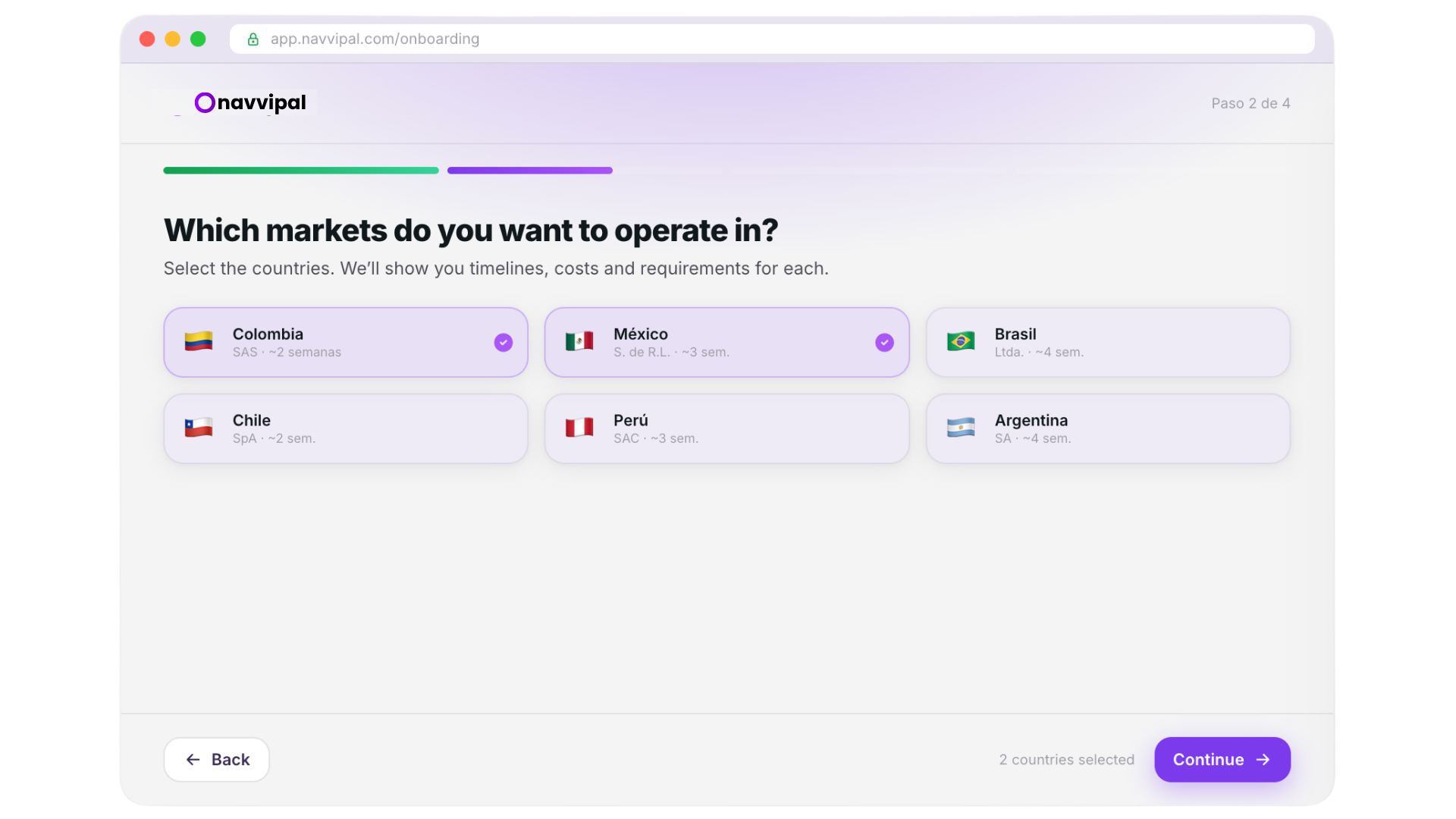
Key Authorities
SENIAT (Servicio Nacional Integrado de Administración Aduanera y Tributaria)
National integrated customs and tax administration responsible for RIF issuance, tax compliance, and revenue collection
SAREN (Servicio Autónomo de Registros y Notarías)
Autonomous registry and notary service responsible for company incorporation and corporate record maintenance
Legal Representative Requirement
Venezuela's Código de Comercio does not require a company's directors to be domiciled in Venezuela (an exception applies to insurance companies). It does require a Venezuela-domiciled legal representative with full powers on file at all times: this is codified for foreign companies operating in Venezuela under Articles 354 through 357, and both SAREN filings and litigation for any entity require an active representative on record. NavviPal provides a qualified local legal representative who acts solely on your company's instructions with full indemnity protections in place.
Frequently Asked Questions
Can NavviPal help me form a new company in Venezuela?
Not as a routine service. NavviPal does not present Venezuela as a formation destination in 2026, given FX controls, mandatory professional requirements and the operating environment. We consider new formation only in narrow cases with a specific strategic rationale and documented risk tolerance. If you are exploring where to incorporate in Latin America, see our locations hub for the markets we do recommend for new entity formation.
Has anything changed with banking or repatriation for Venezuela given OFAC General License 57?
Yes, and it's a genuinely favorable development worth knowing about. OFAC General License 57, issued in April 2026, authorizes certain transactions with specified Venezuelan financial institutions that were previously blocked, partially reopening correspondent banking channels that had been closed for years. This doesn't mean banking is now routine, international banks are still rebuilding relationships case by case and remain cautious, and it doesn't override Venezuela's own domestic FX controls on capital movement. But for existing operators who had written off any banking access as impossible, it's worth a fresh look at what's actually available today rather than assuming the older, more restrictive picture still holds.
What happens if my entity has fallen behind on its filings?
Exposure accumulates the longer filings stay outstanding: unfiled ISLR and IVA periods can carry penalties and interest, and an out-of-date SAREN registration can complicate any later transaction, including dissolution. A particularly severe version of this is the annual shareholders' assembly and comisario (statutory auditor) report, if these lapse for an extended period, commonly cited around 5 years, SAREN can refuse to process any new filing at all until the backlog is cleared, effectively locking the entity out of the registry. Penalty amounts and interest calculations vary based on how far behind the entity is and which filings are missing, so we review each case individually rather than quoting a fixed number. The practical path is to get current period by period, starting with the oldest outstanding filing, rather than attempting to resolve everything at once.
Can I repatriate profits or capital from Venezuela?
Venezuela's FX controls restrict how capital moves out of the country, and the mechanics depend on the current exchange regime in effect. This is a genuine constraint, not a formality: there is no routine workaround. NavviPal can walk you through the current requirements for your specific entity, but we will not represent this as straightforward when it is not.
Do I still need a local legal representative if the entity is dormant?
Yes. Venezuela requires a Venezuela-domiciled legal representative with full powers on file at all times, regardless of whether the entity is actively trading. A dormant entity still needs an active representative on record to remain in good standing with SAREN.
Can I keep the entity dormant instead of dissolving it?
You can, but dormancy is not free: the local legal representative requirement, annual SAREN renewal and, in most cases, ongoing accounting obligations continue whether or not the entity is trading. Weigh the recurring cost of staying dormant against the one-time cost of a formal dissolution. For entities with no near-term plan to resume activity, dissolution is usually the lower-cost path over a multi-year horizon.
How long does it take to dissolve a Venezuelan entity?
A full dissolution, from board resolution through final SAREN deregistration and SENIAT tax clearance, does not follow a fixed timeline: it depends heavily on whether filings are current, whether outstanding liabilities need to be resolved first, and how quickly each authority processes the file. Timelines vary considerably case by case. NavviPal will give you a realistic estimate once we've reviewed your entity's specific status, rather than quoting a generic range that may not hold for your situation.
What does it cost to form a company in Venezuela?
NavviPal's flat fee to form your company in Venezuela is $3,500, covering document preparation and coordination of Registro Mercantil filing and RIF registration. This does not include government, notary, or registry costs, which vary and are billed separately, and Venezuela's FX framework can affect how those costs and any repatriated funds are structured. NavviPal provides transparent, itemized quotes, contact us for your specific scenario.
Related Resources
Cost Calculator
Country Comparisons
Ready to expand into Venezuela?
NavviPal handles company formation, compliance, accounting, and tax obligations so you can focus on building your business.