Company Formation in Panama
Regional financial & logistics hub · 6-10 weeks · RUC · Resident agent required
Formation Process
Panama is one of the more accessible company formation jurisdictions in Latin America. The Sociedad Anónima (S.A.) is the dominant structure, and the Public Registry filing itself can be completed within days once a licensed registered agent has prepared the Pacto Social. Registering the entity, filing the Aviso de Operación business license, and obtaining the RUC tax ID typically take 6 to 10 weeks in total, and opening a corporate bank account is a separate step that commonly adds another 2 to 8 weeks, since Panamanian banks apply enhanced due diligence to foreign-owned structures. No Panamanian nationality is required for directors or shareholders, and Panama's territorial tax system offers significant advantages for international operations.
See the full company formation guideFormation Steps
- 1
Drafting and execution of the Pacto Social (articles of incorporation) by a licensed Panamanian attorney
- 2
Registration with the Public Registry (Registro Público) via the registered agent
- 3
Appointment of a minimum of three directors (any nationality permitted)
- 4
Appointment of a licensed registered agent domiciled in Panama (mandatory by law)
- 5
RUC registration with the DGI (Dirección General de Ingresos), plus the Aviso de Operación business license for any entity conducting commercial activity in Panama
Foreign Ownership
Panama permits 100% foreign ownership across virtually all sectors with no local shareholding or directorship nationality requirements. Panama's legal framework is specifically designed for international holding structures, asset protection vehicles, and regional headquarters. Bearer shares were abolished in 2015, and all ownership is registered. There are no restrictions on profit repatriation, though multinational-group entities relying on the territorial exemption for foreign-source passive income should confirm their exposure to Law 526's 2027 economic substance requirement before assuming that income stays untaxed.
Legal Entity Types
Sociedad Anónima (S.A.)
Stock corporation, the most common structure for both local operations and international holding companies
SRL (Sociedad de Responsabilidad Limitada)
Limited liability company, less common but available for specific business structures
Branch Office
Extension of a foreign entity, used when maintaining a formal subsidiary is unnecessary
Accounting & Tax
Panama operates a territorial tax system: only income generated from sources within Panama is subject to Panamanian corporate income tax, and income earned from outside Panama is generally exempt. Starting fiscal year 2027, Law 526 of 2026 qualifies this for multinational-group entities: foreign-source passive income such as dividends, interest, and royalties becomes taxable at 15% unless the entity can demonstrate real economic substance in Panama, staff, facilities, and local decision-making, not just a registered address. This makes Panama particularly attractive for holding companies, international trading, and regional headquarters that can meet the substance bar.
RUC
The RUC (Registro Único de Contribuyente) is Panama's tax identification number, issued by the DGI (Dirección General de Ingresos). It is required for all business operations, tax filings, and regulatory compliance.
VAT / IVA
Panama's ITBMS (Impuesto de Transferencia de Bienes Muebles y Servicios), VAT, is levied at 7% on most goods and services. A 10% rate applies to alcoholic beverages, and a 15% rate to tobacco. Panama's VAT rate is among the lowest in Latin America. Monthly ITBMS declarations are required for entities with commercial activity in Panama.
Corporate Tax
Corporate income tax applies at 25% to net taxable income from Panamanian sources. For companies with taxable income above $1.5 million, the CAIR comparison uses the greater of ordinary tax or 4.67% of gross taxable income. Foreign-source income is generally exempt under the territorial system. From fiscal year 2027, certain multinational-group entities may instead owe 15% on foreign-source passive income unless they meet the economic-substance requirements in Law 526 of 2026.
Compliance Requirements
Annual Obligations
Annual corporate income tax return filed with DGI: deadline March 31
Annual fixed $300 franchise tax (Tasa Única) payment, due January 15 or July 15 depending on the incorporation date, with unpaid balances after 3 or more consecutive years risking suspension of corporate rights under Panama's active 2026 administrative dissolution program, which has already dissolved roughly 290,000 to 300,000 non-compliant entities
Annual beneficial ownership declaration filed with the DGI (required since 2016)
Monthly Obligations
Monthly ITBMS (VAT) declaration for entities with commercial activity in Panama
Monthly retención en la fuente (withholding tax) declaration if applicable
Monthly CSS (social security) contributions if employing staff in Panama
Maintenance of registered agent relationship and registered address in Panama
Payroll & Employment
Panama's labor framework is governed by the Código de Trabajo. Panama has a structured social security system administered by the CSS (Caja de Seguro Social), with employer contributions among the more significant in Central America.
Mandatory benefits include 13th month salary (décimo tercer mes, paid in three tranches: April, August, December), minimum 30 days paid vacation per year, and seniority premium (prima de antigüedad)
CSS contributions: employer approximately 12.25% of gross salary, employee approximately 9.75%; mandatory for all employees working in Panama
Educational insurance (seguro educativo): employer 1.5%, employee 1.25%, applies in addition to CSS contributions
NavviPal coordinates payroll processing and Código de Trabajo compliance through vetted Panamanian in-country partners. Contact our team to understand your full employer cost structure.
Talk To An ExpertWhy Panama
Panama's appeal for holding companies and regional operations rests on its territorial tax system, its fully dollarized economy, and a formation process that itself moves quickly once a licensed resident agent has prepared the Pacto Social. The tradeoffs are real: every entity must maintain that resident agent continuously, since a gap of more than 90 days suspends the company's corporate rights, and Panamanian banks apply enhanced due diligence to foreign-owned structures, which is why corporate bank account opening, not incorporation, is the actual bottleneck for most foreign investors. A 2026 government program has also been administratively dissolving long-dormant, non-compliant entities, a real consideration for anyone planning to hold a Panama structure inactively rather than operate it.
4.4M
Population
~$80B USD
GDP (2024 est.)
USD (Balboa)
Currency
6-10 weeks
Formation Time
Managing Your Entity with NavviPal
NavviPal's platform tracks your Panamanian entity's RUC status, DGI filing calendar, annual franchise tax deadlines, and beneficial ownership compliance requirements.
Explore the Platform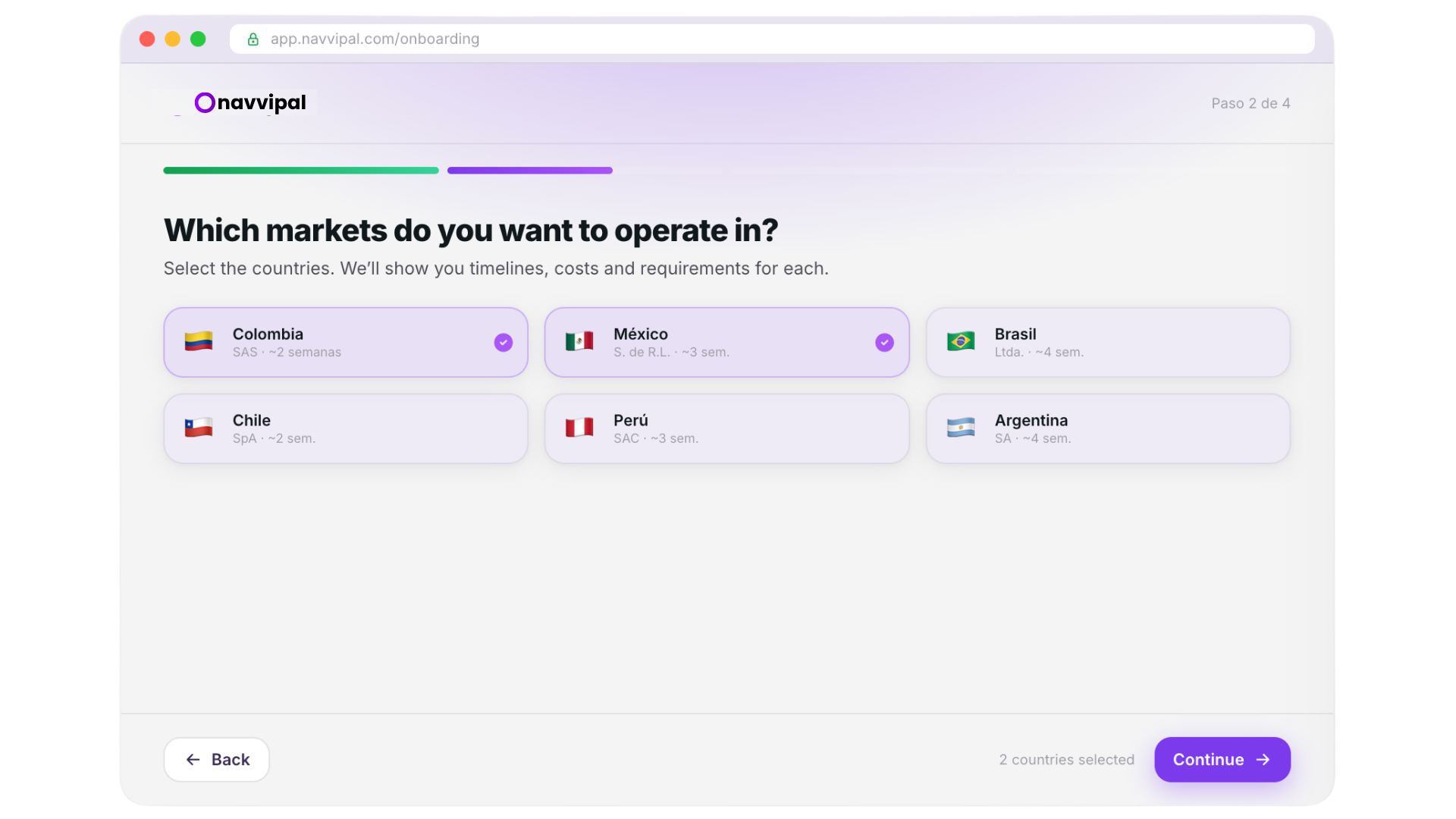
Key Authorities
DGI (Dirección General de Ingresos)
General revenue directorate responsible for RUC issuance and tax administration
Public Registry of Panama
Official registry where companies are incorporated and corporate records are maintained
Resident Agent Requirement
Panama does not require directors to be Panamanian nationals or residents. The law requires a minimum of three directors or officers, typically a President, Secretary, and Treasurer, who can be of any nationality and don't need to live in Panama. What is mandatory is a licensed Panamanian resident agent, an attorney or law firm that must be maintained on record at all times: if the company goes more than 90 days without one, the Public Registry suspends its corporate rights, with fines of $1,000 plus $100 per day until the gap is cured. NavviPal provides resident agent services as part of our corporate package.
Frequently Asked Questions
How long does company formation take in Panama?
Registering the entity itself with the Public Registry can be completed within days once a licensed registered agent has prepared the Pacto Social. A foreign investor should realistically budget 6 to 10 weeks for the full process, including the Aviso de Operación business license and RUC tax registration with the DGI. Opening a corporate bank account is a separate, often slower step, typically adding another 2 to 8 weeks, since Panamanian banks apply enhanced due diligence to foreign-owned structures. Incorporation speed is a real advantage of Panama, but the realistic timeline to a fully operational entity with a working bank account is longer than incorporation alone.
Do I need a local director or legal representative in Panama?
Panama requires at least three directors for a Sociedad Anónima. There is no nationality requirement for directors, they can be foreign nationals. A licensed registered agent domiciled in Panama is mandatory by law and must be maintained throughout the company's life.
S.A. or SRL: which entity type should I choose in Panama, and is there a Panama LLC?
Panama doesn't have an LLC in the US sense. Most US-based readers searching for a Panama LLC are actually looking at the Sociedad Anónima (S.A.), Panama's dominant vehicle for both international holding structures and local operations, or occasionally the SRL (Sociedad de Responsabilidad Limitada), a less commonly used limited liability form. The S.A. requires a minimum of three directors of any nationality and is governed by Panama's century-old, well-tested corporate law (Law 32 of 1927), a major reason it remains the default choice for asset protection and holding structures. The SRL suits founders who want a simpler, member-managed structure closer to a US LLC in spirit, but it sees far less use in practice and has less established case law behind it. Both permit 100% foreign ownership with no local shareholding requirement.
What does it cost to form a company in Panama?
NavviPal's flat fee to form your company in Panama is $3,500, covering incorporation, RUC registration, and formation-stage coordination with your resident agent. This does not include Panama's government formation charges, apostille, or translation costs, which are billed separately, nor the fixed $300 annual tasa única franchise tax due starting in year two. NavviPal provides transparent, itemized quotes, contact us for your specific scenario.
What is the RUC and why is it needed?
The RUC (Registro Único de Contribuyente) is Panama's tax identification number, issued by the DGI (Dirección General de Ingresos). It is required for tax filings, commercial operations, banking, and any entity conducting business activity in Panama, including companies operating under Panama's territorial tax system.
What are the ongoing compliance obligations in Panama?
Panamanian entities must pay an annual franchise tax, maintain a mandatory licensed registered agent, file beneficial ownership declarations with the DGI, and submit annual financial statements if operating commercially in Panama. Panama's territorial tax system means income earned outside Panama is generally exempt from corporate income tax.
What documents are needed to incorporate in Panama?
Core requirements include: Pacto Social (articles of incorporation) filed with the Public Registry, appointment of a licensed registered agent (mandatory), RUC registration with DGI, the Aviso de Operación business license for any entity conducting commercial activity in Panama, and apostilled copies of director and shareholder identification documents. The registered agent handles most Public Registry filing on your behalf.
Related Resources
Cost Calculator
Country Comparisons
Ready to expand into Panama?
NavviPal handles company formation, compliance, accounting, and tax obligations so you can focus on building your business.