
Company Formation in Costa Rica
Stable tech & services hub · 6–10 weeks · Cédula Jurídica · No local director required
Formation Process
Costa Rica offers one of Central America's most investor-friendly company formation environments. The Sociedad Anónima (S.A.) and Sociedad de Responsabilidad Limitada (SRL) are the most common structures. The process involves notarization by a Costa Rican notario público, registration with the National Registry (Registro Nacional), and Cédula Jurídica issuance from the Ministerio de Hacienda. No local directors or shareholders are required.
See the full company formation guideFormation Steps
- 1
Notarization of articles of incorporation (escritura constitutiva) before a Costa Rican notario público
- 2
Registration with the Registro Nacional (National Registry), Registro Mercantil section
- 3
Cédula Jurídica registration with the Ministerio de Hacienda (tax authority)
- 4
Registration with the CCSS (Caja Costarricense de Seguro Social) if employing staff
- 5
Municipal business license (Patente Municipal) from the operating municipality
Foreign Ownership
Costa Rica allows 100% foreign ownership with minimal restrictions. No Costa Rican director or shareholder is required for most corporate structures. Costa Rica has a stable legal framework, a strong rule-of-law tradition, and signed investment protection agreements with major trading partners. Restrictions are limited to specific regulated sectors such as fishing, public utilities, and professional services that require local licensing.
Legal Entity Types
Sociedad Anónima (S.A.)
Stock corporation, the most common structure for both local and international businesses in Costa Rica
SRL (Sociedad de Responsabilidad Limitada)
Limited liability company, suitable for smaller operations with defined ownership structures
Accounting & Tax
All entities operating in Costa Rica must register with the Ministerio de Hacienda and obtain a Cédula Jurídica before commencing business. Costa Rica introduced mandatory electronic invoicing (factura electrónica) for all commercial transactions, managed through the ATVE system.
Cédula Jurídica
Costa Rica's tax identification number issued by the Ministerio de Hacienda. It is required for all tax filings, business transactions, and regulatory compliance.
VAT / IVA
Costa Rica's IVA (VAT) is levied at a general rate of 13% on goods and services. Reduced rates of 4% apply to private health and education, and 2% applies to medicines and insurance premiums. Monthly IVA declarations are filed electronically through the Ministerio de Hacienda's ATV portal.
Corporate Tax
Costa Rica's corporate income tax (Impuesto sobre las Utilidades) is a flat 30% on gross annual income above ₡119,174,000, the bracket most foreign-owned subsidiaries fall into. A reduced progressive scale, 5% up to ₡5.58M, 10% up to ₡8.38M, 15% up to ₡11.17M, and 20% above that, applies only to smaller taxpayers below the threshold. Entities not generating income pay a flat Timbre (territorial fee). Monthly advance payments are required.
Compliance Requirements
Annual Obligations
Annual corporate income tax return filed with the Ministerio de Hacienda through TRIBU-CR, due March 15
Annual beneficial ownership report (Registro de Transparencia y Beneficiarios Finales, RTBF), filed April 1-30; missing this filing blocks the Registro Nacional from processing any other filing or issuing certifications until it's resolved
Annual Patente Municipal renewal with the operating municipality
Monthly Obligations
Monthly IVA (VAT) declaration filed electronically via the ATV portal
Monthly CCSS (social security) contributions if employing staff
Monthly electronic invoicing compliance via ATVE for all commercial transactions
Monthly INS (Instituto Nacional de Seguros) workers' compensation premium if employing staff
Payroll & Employment
Costa Rica's labor framework is governed by the Código de Trabajo. Costa Rica has a well-developed social security system administered by the CCSS, with employer contributions being a significant component of total employment cost.
Mandatory benefits include minimum 15 days paid vacation per year (increasing with seniority), annual Christmas bonus (Aguinaldo, 1 month salary, paid December), and legal severance (auxilio de cesantía, up to 8 years)
CCSS contributions: employer approximately 26.17% of gross salary (health + pension + other funds), employee approximately 10.67%, among the higher rates in Central America
All employment relationships must be registered with the CCSS from day one: failure to register carries significant penalties and back-contribution liability
NavviPal coordinates payroll processing and Código de Trabajo compliance through vetted Costa Rican in-country partners. Contact our team before your first hire.
Talk To An ExpertWhy Costa Rica
Costa Rica combines a strong rule-of-law tradition with straightforward foreign ownership: no local director or shareholder is required, and a licensed Costa Rican attorney is needed as resident agent only when none of the company's representatives is domiciled in the country. English-language proficiency, proximity to the U.S., and established free trade zones make it a leading nearshoring destination for shared service centers, technology companies, and medical device manufacturers, though ongoing beneficial-ownership and corporate-tax filings still require year-round attention to stay in good standing.
5.2M
Population
~$65B USD
GDP (2024 est.)
Rule of law & stability
Key Strength
6–10 weeks
Formation Time
Managing Your Entity with NavviPal
NavviPal's platform tracks your Costa Rican entity's Cédula Jurídica status, Ministerio de Hacienda filing deadlines, RTBF beneficial ownership compliance, and CCSS contribution schedules.
Explore the Platform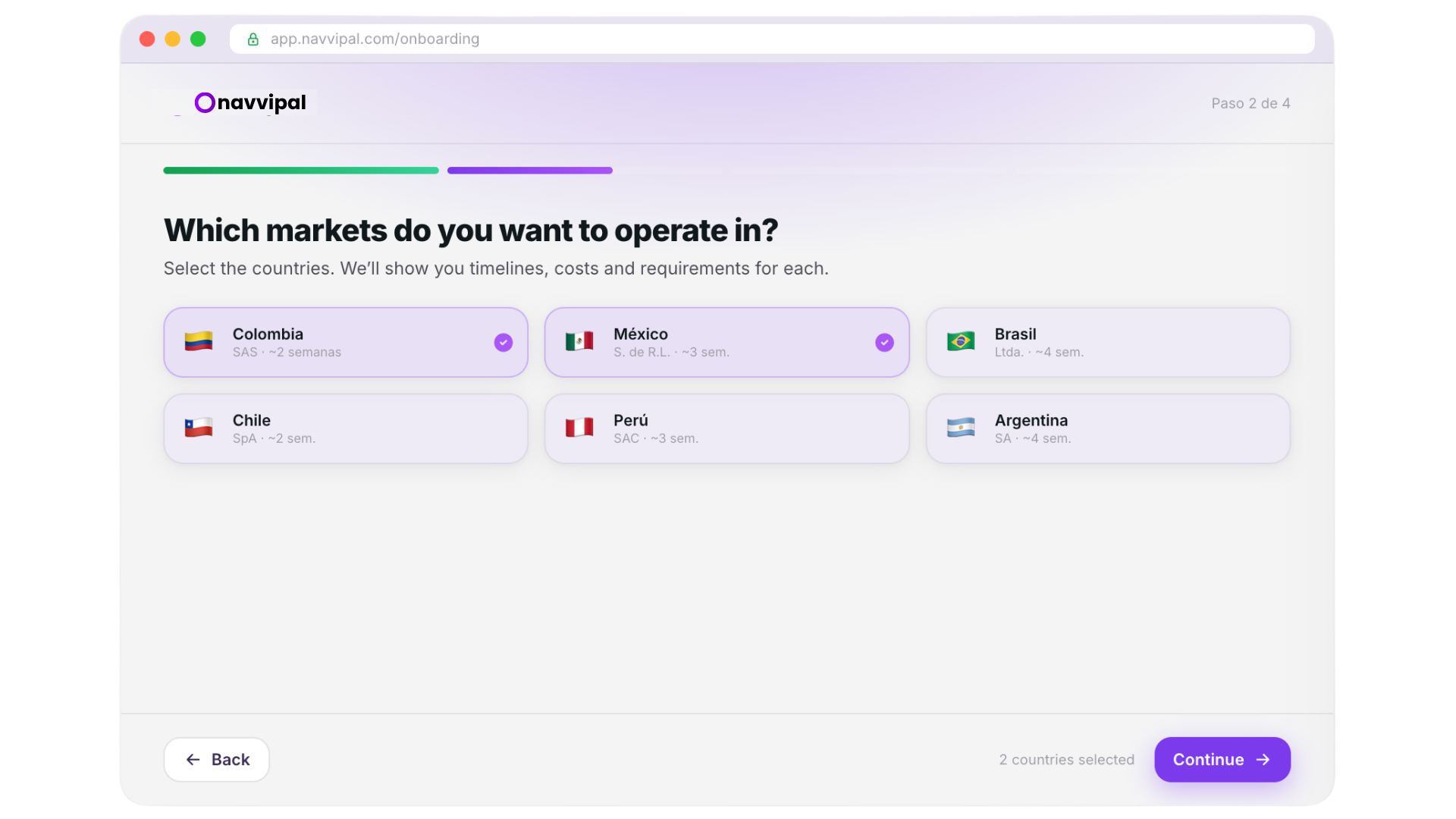
Key Authorities
Ministerio de Hacienda
Ministry of Finance responsible for tax administration and NITE issuance
Registro Nacional
National registry where companies are officially incorporated and corporate records are maintained
Resident Agent Requirement
Costa Rica does not require local directors or shareholders for most corporate structures. Foreign individuals can serve as directors and own 100% of the company. A 2025 law change removed the general resident agent requirement, replacing it with a registered official email address in the incorporation deed; a licensed Costa Rican attorney must still be appointed as resident agent only if none of the company's representatives are domiciled in the country.
Frequently Asked Questions
How long does company formation take in Costa Rica?
Company formation in Costa Rica typically takes 6-10 weeks end to end. Incorporation itself, notarizing the articles of incorporation (escritura constitutiva), registration with the National Registry (Registro Nacional), and Cédula Jurídica issuance from the Ministerio de Hacienda, can take as little as 1 to 2 weeks once documents are ready, but foreign founders using an apostilled power of attorney should expect the full process, including opening a corporate bank account, to run closer to 6 to 10 weeks.
Do I need a local director or legal representative in Costa Rica?
Costa Rica does not require local directors or shareholders for most corporate structures. Foreign individuals and companies can fully own and manage a Costa Rican entity. A Costa Rican notario público is required to notarize the incorporation documents, but ongoing local director presence is not mandatory. If none of the company's representatives is domiciled in Costa Rica, a licensed Costa Rican attorney must be appointed as resident agent to receive legal communications.
Can foreigners own 100% of a company in Costa Rica, and what does investing here as a foreigner actually involve?
Yes. Costa Rica allows 100% foreign ownership with minimal restrictions, no Costa Rican director or shareholder is required, and a foreign national can serve as the entity's sole shareholder and administrator. In practice, investing as a foreigner mainly means budgeting for the steps a local founder skips: apostilled and translated identity documents, a local legal representative for banking and registry purposes if you won't be resident, and the RTBF beneficial-ownership filing due within the deadline after incorporation. Restrictions on foreign ownership itself are limited to specific sectors such as fishing and public utilities.
What does it cost to form a company in Costa Rica?
NavviPal's flat fee to form your company in Costa Rica is $4,500, covering document preparation and coordination of notarization, National Registry filing, and Cédula Jurídica registration. This does not include government, notary, or registry costs, which vary and are billed separately. Ongoing costs include annual corporate tax, accounting, and beneficial ownership compliance. NavviPal provides transparent, itemized quotes, contact us for your specific scenario.
What is the Cédula Jurídica and why is it needed?
The Cédula Jurídica is Costa Rica's unique corporate identification and tax number, issued by the Ministerio de Hacienda and registered with the National Registry. It is required for banking, contracts, tax filings, beneficial ownership declarations, and all commercial activities. It serves as both the legal entity identifier and the primary tax number.
How do I liquidate or dissolve a company in Costa Rica?
Since Circular DPJ-001-2025, closing a Costa Rican S.A. or S.R.L. can be materially simpler than before: dissolution and liquidation can be completed in a single protocolized act, and appointing a liquidator can be skipped entirely if a notary certifies the company has no assets or liabilities. Companies with real assets or debts still need a liquidator to settle creditors and distribute remaining funds, with the agreement published in La Gaceta to open a roughly one-month creditor claim period. Before any of this can proceed, outstanding RTBF beneficial-ownership filings and unpaid impuesto a personas jurídicas must be resolved, the Registro Nacional will not process a dissolution for a company flagged non-compliant on either. A simplified zero-asset closure can take weeks; a standard liquidation with real assets and creditors runs 6 to 12 months.
What documents are needed to incorporate in Costa Rica?
Core requirements include: articles of incorporation (escritura constitutiva) notarized before a Costa Rican notario público, registration with the National Registry (Registro Nacional), Cédula Jurídica registration with the Ministerio de Hacienda, apostilled copies of foreign shareholder identification documents, and a registered address in Costa Rica.
Related Resources
Cost Calculator
Country Comparisons
Ready to expand into Costa Rica?
NavviPal handles company formation, compliance, accounting, and tax obligations so you can focus on building your business.