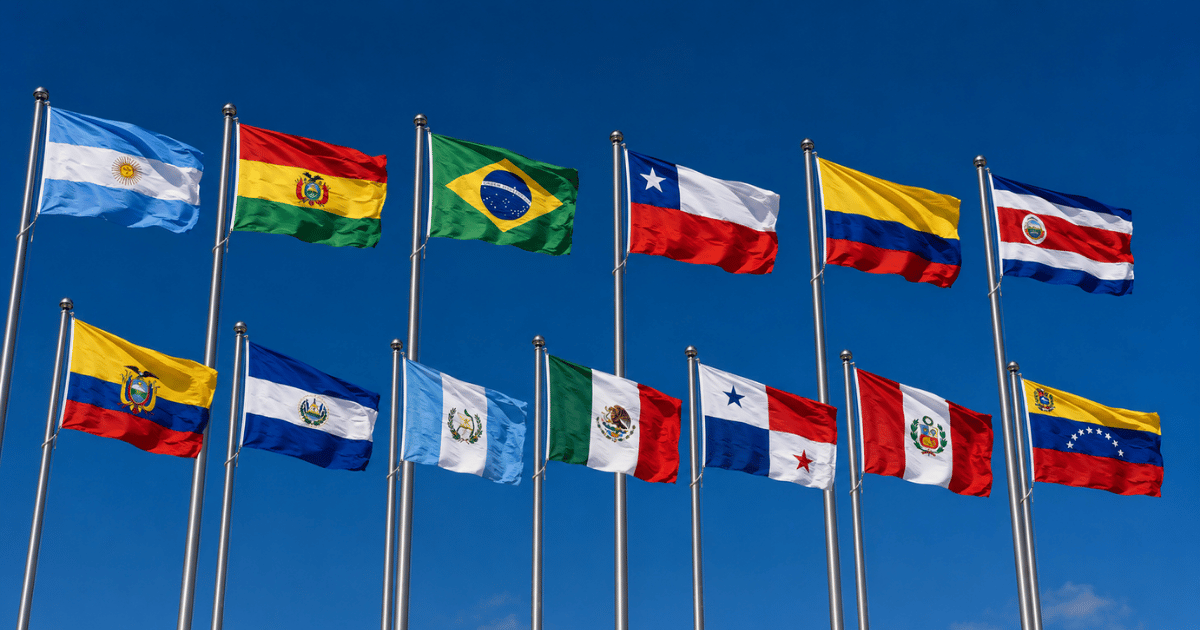
There is no single best country to incorporate in Latin America, only the best fit for what you're trying to do. A company hiring a handful of engineers has different priorities than one building a regional distribution hub or a holding structure. The markets differ sharply on how easy they are to enter, how much foreign ownership they allow, how heavy the ongoing compliance is, and how quickly you can be up and running. This guide compares all 13 markets NavviPal operates in, as of mid-2026, so you can match the market to your goals rather than the other way around.
What actually matters when choosing
Before comparing countries, it helps to be clear about the criteria that move the decision:
- Foreign ownership. Most of the region allows 100% foreign ownership in the majority of sectors, but the practicalities vary: local representative requirements, resident directors.
- Entity flexibility. Some countries offer a modern, single-shareholder vehicle; others still expect two or more owners and heavier formalities.
- Speed and complexity of setup. Whether incorporation runs through a notarized deed or a simple private document makes a real difference to timelines.
- Ongoing compliance burden. The monthly and annual filing load after incorporation matters more than the setup itself. It's a recurring cost, not a one-time one.
- Banking and capital movement. How easily you can open a corporate account and move money in and out is often the true bottleneck.
- Market and talent access. Ultimately, why you're there: the customers or the workforce.
The quick comparison
Timelines below are NavviPal's standard formation-timeline estimate for a foreign-owned entity in each market, as shown on each country's page.
| Country | Common entity | Foreign ownership | Setup complexity | End-to-end timeline | Best suited for |
|---|---|---|---|---|---|
| Mexico | S. de R.L. de C.V. | 100% (most sectors) | Medium | 6–9 weeks | Nearshoring, manufacturing, USMCA-linked trade |
| Colombia | S.A.S. | 100% (most sectors) | Low–Medium | 2–4 weeks | Fast, low-friction entry; Andean hub |
| Brazil | Limitada (Ltda.) | 100% (most sectors) | High | 6–10 weeks | The largest domestic market, if you can absorb complexity |
| Chile | SpA | 100% (most sectors) | Low | 6–8 weeks | Regional HQ; efficient, stable environment |
| Costa Rica | S.R.L. | 100% (most sectors) | Low–Medium | 3–5 weeks | Nearshore services in a bilingual, stable base |
| Peru | S.A.C. | 100% (most sectors) | Medium | 4–6 weeks | Andean operations and resources sector |
| Panama | S.A. | 100% (most sectors) | Low–Medium | 2–3 weeks | Holding structures; regional HQ; USD economy |
| Argentina | S.A.S. / S.R.L. | 100% (most sectors) | High | 6–10 weeks | Targeting the Argentine market or its talent pool |
| Ecuador | S.A.S. | 100% (most sectors) | Low–Medium | 3–5 weeks | Dollarized Andean base for trade and services |
| Guatemala | S.A. | 100% (most sectors) | Medium | 4–6 weeks | Central America's largest economy; manufacturing and distribution |
| El Salvador | S.A. de C.V. | 100% (most sectors) | Medium | 4–8 weeks | USD economy; services and light operations |
| Bolivia | S.R.L. | 100% (most sectors) | High | 6–10 weeks | Resources and Andean supply chains |
Complexity here is a practical judgment about setup and ongoing administration, not a measure of the opportunity. A "High" market can still be the right choice. It just needs more planning and budget.
Country by country
Mexico
The region's most common gateway for foreign companies, particularly for nearshoring and USMCA-linked trade. The S. de R.L. de C.V. allows full foreign ownership, and the framework is well established, though incorporation runs through a notary and monthly tax filings begin immediately. Full detail in our Mexico company formation guide and on the Mexico country page.
Colombia
Often the fastest, lowest-friction entry in the region thanks to the S.A.S., which can be formed by a private document, with no notarized deed required, and can have a single shareholder. The one step foreign founders must not skip is registering their investment with the central bank to protect future remittances. See the Colombia company formation guide and the Colombia country page.
Brazil
The largest economy and market in Latin America, and the most operationally complex to enter. The Limitada allows full foreign ownership, but you'll need a resident administrator, and the tax system is famously layered, currently in the middle of a multi-year reform introducing a new dual VAT. Brazil rewards companies that genuinely need its market and plan for the overhead. See our Brazil company formation guide and the Brazil country page.
Chile
Widely regarded as one of the most business-friendly, stable environments in the region, with efficient and increasingly digital processes. The SpA (simplified stock corporation) is flexible and popular with foreign investors, making Chile a common choice for a regional headquarters. See our Chile company formation guide and the Chile country page.
Costa Rica
A stable, bilingual base favored for nearshore services and regional operations. The S.R.L. requires no minimum capital, but the country pairs incorporation with a flat annual legal-entity tax and a beneficial-ownership filing that apply even to dormant companies. See the Costa Rica company formation guide and the Costa Rica country page.
Peru
A growing market and a practical base for Andean operations and the resources sector. The S.A.C. (closed corporation) is the standard vehicle for foreign-owned businesses, with a straightforward registration path. See the Peru country page.
Panama
Distinctive for its territorial tax system, under which income earned outside Panama is generally not taxed locally, and its USD-based economy. The S.A. is the workhorse entity, and Panama is strong for holding structures and regional headquarters, though less oriented toward selling into a large domestic market. Expect real substance and transparency expectations. See the Panama country page.
Argentina
A large economy with an exceptional talent pool, but currency controls and persistent inflation add a layer of complexity that shapes every decision about moving money in and out. Argentina tends to make sense when you specifically want its market or its people, with structuring done deliberately. See our Argentina company formation guide and the Argentina country page.
Ecuador
A dollarized economy and an increasingly simple entry point since the introduction of its S.A.S., which allows single-shareholder formation with light formalities. A practical Andean base for trade and services without currency risk. See the Ecuador country page.
Guatemala
Central America's largest economy and a natural base for manufacturing and regional distribution. The S.A. is the standard vehicle, and while the process is paper-heavy, ongoing administration is manageable once established. See the Guatemala country page.
El Salvador
A fully USD economy with a compact, service-oriented market. The S.A. de C.V. is the common choice for foreign-owned entities, and the dollarization removes the currency management burden that complicates larger markets. See the El Salvador country page.
Bolivia
A resources-driven economy where formation and administration are more bureaucratic than the regional norm, which is why it sits in the "High" complexity tier. It makes sense for companies with a specific reason to be there: mining services, Andean supply chains, or regional coverage requirements. See the Bolivia country page.
A note on Venezuela
Venezuela is not a routine incorporation destination in 2026, and we don't present it as one. NavviPal supports companies that already have Venezuelan entities with maintenance, compliance, and exit planning. If that's your situation, see the Venezuela page.
How to choose
A few common scenarios:
- Hiring a team quickly with minimal friction — Colombia or Chile, for speed and a clean setup.
- Manufacturing or nearshoring for North America — Mexico, for USMCA access and infrastructure.
- Reaching the largest possible domestic market — Brazil, provided you budget for the complexity.
- A regional holding or headquarters — Panama or Chile, depending on whether tax structure or operating environment leads.
- Nearshore services in a stable, bilingual base — Costa Rica.
- A dollarized base without the scale of Mexico or Brazil — Ecuador, El Salvador, or Panama.
If you've narrowed it to two markets, our head-to-head comparison pages go deeper on exactly this decision. Start with Brazil vs Mexico, the region's most common shortlist.
The honest answer for most companies expanding regionally is that the "best" country is the one where your customers or your talent already are, and the structuring question is how to enter it cleanly and stay compliant, not which flag looks best on paper.
Frequently asked questions
What is the easiest country to start a business in Latin America? For a foreign company, Colombia and Chile are typically the lowest-friction entries as of 2026. Colombia's S.A.S. forms by private document with a single shareholder, and Chile's processes are among the region's most digital. "Easiest" still means weeks, not days, once foreign shareholder documents, tax registration, and banking are counted.
Which country is cheapest for incorporation? Setup costs across most of the region fall in a similar low-four-figure USD band when handled professionally, so formation price alone rarely decides it. The bigger cost difference is ongoing compliance: high-complexity markets like Brazil and Argentina carry a heavier recurring administrative load than Chile or Colombia.
Which Latin American country has the lowest taxes for foreign companies? Panama's territorial system generally doesn't tax income earned outside Panama, which is why it dominates holding-structure conversations. For operating companies selling locally, effective tax burden depends on the market you're in, and substance requirements mean a low-tax flag without real operations behind it invites scrutiny.
Can a foreigner own 100% of a company in Latin America? In all 13 markets covered here, 100% foreign ownership is permitted in most sectors as of 2026. The practical caveats are sector restrictions (media, border-zone land, some regulated industries, depending on the country) and local requirements like a resident legal representative or administrator.
Should I incorporate in one country or several? Start where your first customers or hires are, and expand entity by entity as revenue justifies the compliance cost. Each entity carries its own recurring filing burden, so a multi-country footprint should follow the business, not precede it.
Choosing with NavviPal
NavviPal forms and maintains legal entities across 13 Latin American markets. If you're weighing two or three countries, we can map the entity type, setup path, timeline, and ongoing compliance for each against your specific plans, so the decision is grounded in your situation rather than a generic ranking. Talk to our team to compare your shortlist.
Figures last verified: July 2026. This article is for informational purposes only and does not constitute legal or tax advice.
Ready to expand into Latin America?
NavviPal manages the full compliance lifecycle for your LATAM entities. Let's talk about your expansion.
Get in Touch