
Company Formation in Brazil
Latin America's largest economy · 6–10 weeks · CNPJ · Local director required
6-10 weeks
CNPJ
Required
Formation Process
Incorporating a company in Brazil is one of the more complex processes in Latin America, involving notarization, state-level registration with the Junta Comercial, and federal CNPJ registration with the Receita Federal. A qualified Brazilian legal representative is required throughout.
Formation Steps
- 1
Notarization of articles of incorporation (contrato social or estatuto social) before a Brazilian notary
- 2
Registration with the Junta Comercial (state Board of Trade) in the state of operations
- 3
CNPJ registration with the Receita Federal (federal tax authority)
- 4
Municipal registration and business license (Alvará de Funcionamento)
- 5
Appointment of a qualifying legal representative (CPF holder — Brazilian national or permanent resident)
- 6
Foreign investment registration with the Central Bank of Brazil (BACEN) if applicable
Foreign Ownership
Foreign nationals can own 100% of a Brazilian entity in most sectors. A Brazilian national or permanent resident must serve as legal representative (administrador) — this is an operational role, not an equity requirement. Sector-specific restrictions apply in healthcare, media, aviation, and land acquisition near borders. All foreign investment must be registered with BACEN via the RDE/ROF system.
Local Director: Required
Legal Entity Types
LTDA (Sociedade Limitada)
Limited liability company, the most common structure for foreign businesses entering Brazil
Sociedade Anônima (S.A.)
Stock corporation, typically used for larger enterprises or companies planning to raise capital
Branch Office
Extension of a foreign entity, requires authorization from the Central Bank and involves more complex setup
Accounting & Tax
All entities operating in Brazil must register for a CNPJ with the Receita Federal before commencing business. Brazil operates a complex multi-layered tax system with federal, state, and municipal obligations that begin from the incorporation date.
CNPJ
The CNPJ (Cadastro Nacional da Pessoa Jurídica) is Brazil's federal tax identification number, required for all companies operating in the country. It is issued by the Receita Federal and is essential for opening bank accounts, hiring employees, and conducting business activities.
VAT / IVA
Brazil has multiple indirect taxes: ICMS (state VAT, 7–18%), ISS (municipal services tax, 2–5%), PIS/COFINS (federal contribution taxes, 1.65–7.6%), and IPI (excise tax for manufacturing). The Simples Nacional regime simplifies tax for qualifying small businesses. Monthly electronic filing is mandatory.
Corporate Tax
Corporate income tax (IRPJ) is levied at 15% on net taxable income, with a 10% surtax on profits exceeding R,000/year. A 9% Social Contribution on Net Income (CSLL) applies additionally. Effective combined rate for most companies is approximately 34%.
Compliance Requirements
Annual Obligations
Annual corporate income tax return (DIRPJ/ECF) filed with the Receita Federal by July 31
Annual statutory financial statements and shareholder meeting (Assembleia Geral Ordinária)
Annual RAIS (labor relations report) filed with the Ministry of Labor
Monthly Obligations
Monthly SPED EFD-ICMS/IPI and EFD-Contribuições (federal digital bookkeeping submissions)
Monthly DCTF declaration (federal tax liabilities — PIS, COFINS, IRPJ, CSLL)
Monthly PGDAS-D filing for Simples Nacional entities (if applicable)
Monthly eSocial and REINF payroll and benefit declarations (if employing staff)
Payroll & Employment
Brazil has one of the most comprehensive labor frameworks in Latin America, governed by the Consolidação das Leis do Trabalho (CLT). Employers face significant mandatory benefit obligations that substantially increase the effective cost of employment.
Mandatory benefits include 13th month salary (décimo terceiro), 30 days paid vacation plus 1/3 vacation bonus, FGTS (8% severance fund contribution), and transport/meal vouchers
Monthly INSS (social security) contributions: employer rate approximately 20–22.5% of gross salary, plus RAT (accident risk) and third-party contributions
eSocial platform handles all payroll, benefits, and employment event reporting digitally — non-compliance carries significant penalties
NavviPal coordinates payroll processing and CLT compliance through vetted Brazilian in-country partners. Contact our team before your first hire to understand your full employer cost structure.
Talk To An ExpertWhy Brazil
Brazil is Latin America's largest economy and the world's 8th-largest by GDP, with a consumer market of 215 million people, deep manufacturing capacity, and a rapidly growing technology sector. It is the dominant entry point for companies targeting the broader Latin American market.
215M
Population
.1T USD
GDP (2024 est.)
~3.2% p.a.
GDP Growth
Top 10
Global GDP Rank
Managing Your Entity with NavviPal
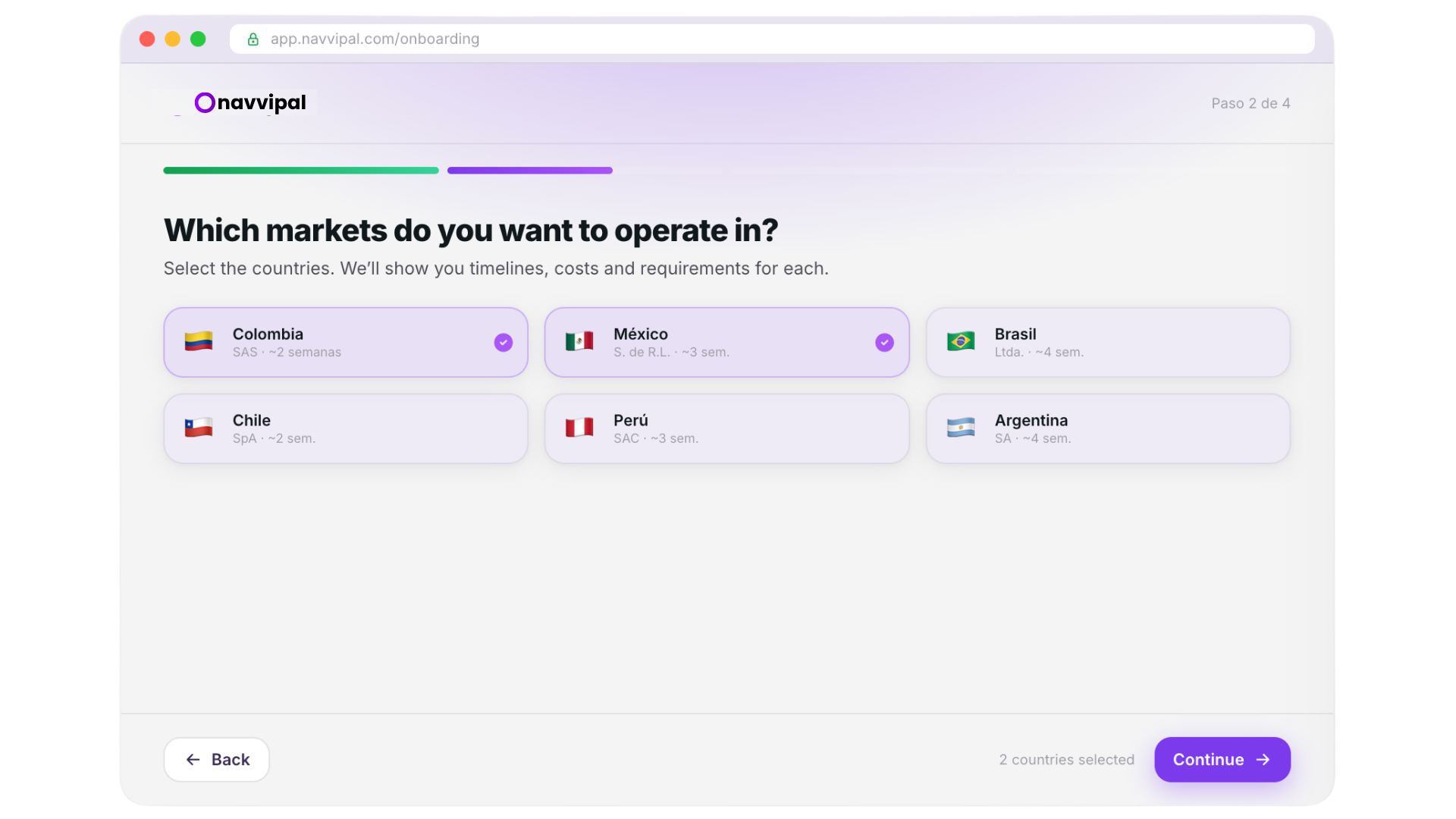
NavviPal's platform tracks your Brazilian entity's CNPJ status, SPED filing calendar, Receita Federal obligations, and multi-layer tax deadlines in a single compliance dashboard.
Key Authorities
Receita Federal
Federal tax authority responsible for CNPJ registration and tax compliance oversight
Junta Comercial
State-level commercial registry where companies are officially registered
Local Director Requirement
Brazil requires at least one legal representative who is a Brazilian national or holds permanent residency. NavviPal provides a qualified local legal representative to satisfy this requirement, acting solely on your company's instructions with full indemnity protections in place.
Frequently Asked Questions
How long does company formation take in Brazil?
Company formation in Brazil typically takes 6-10 weeks. The process includes notarization of incorporation documents, registration with the Junta Comercial (state Board of Trade), and CNPJ registration with the Receita Federal. Brazil's multi-layered bureaucracy accounts for the longer timeline compared to markets like Colombia or Panama.
Do I need a local director or legal representative in Brazil?
Yes. Brazil requires at least one legal representative (sócio-administrador or diretor) who is a Brazilian national or holds permanent residency in Brazil. Foreign shareholders can hold 100% of the economic interest, but a qualifying local administrator is mandatory for signing documents, managing regulatory filings, and operating the entity.
Can foreigners own 100% of a company in Brazil?
Yes, foreign nationals can own 100% of a Brazilian entity in most sectors. A Brazilian national or permanent resident must act as legal representative (administrador), but does not need to hold equity. Sector-specific restrictions apply in healthcare, media, aviation, and land near borders. Foreign investment must be registered with the Central Bank of Brazil (BACEN).
What does it cost to form a company in Brazil?
Company formation in Brazil typically ranges from ,500 to ,000 USD for the core process, depending on entity type, state of registration, and complexity. Ongoing costs include accounting, tax compliance, and the local administrator. NavviPal provides transparent, itemized quotes—contact us for your specific scenario.
What is the CNPJ and why is it needed?
The CNPJ (Cadastro Nacional da Pessoa Jurídica) is Brazil's federal tax identification number, issued by the Receita Federal. It is required for all business activities in Brazil—including opening bank accounts, signing contracts, issuing invoices, hiring employees, and filing taxes. Without an active CNPJ, your entity cannot legally operate.
What are the ongoing compliance obligations in Brazil?
Brazilian entities must file monthly tax declarations at federal, state, and municipal levels; submit SPED reports (Brazil's digital bookkeeping system); prepare annual statutory accounts and corporate filings; and maintain monthly accounting records. Brazil's compliance burden is among the highest in Latin America—professional accounting support is effectively mandatory.
What documents are needed to incorporate in Brazil?
Core requirements include: notarized articles of incorporation (contrato social or estatuto social), apostilled and translated copies of foreign shareholder identification documents, proof of a Brazilian registered address, appointment of a qualifying legal representative (CPF holder), and initial foreign investment registration with the Central Bank if applicable. Requirements vary by state and entity type.
Related Resources
Country Comparisons
Ready to expand into Brazil?
NavviPal handles company formation, compliance, accounting, and tax obligations so you can focus on building your business.